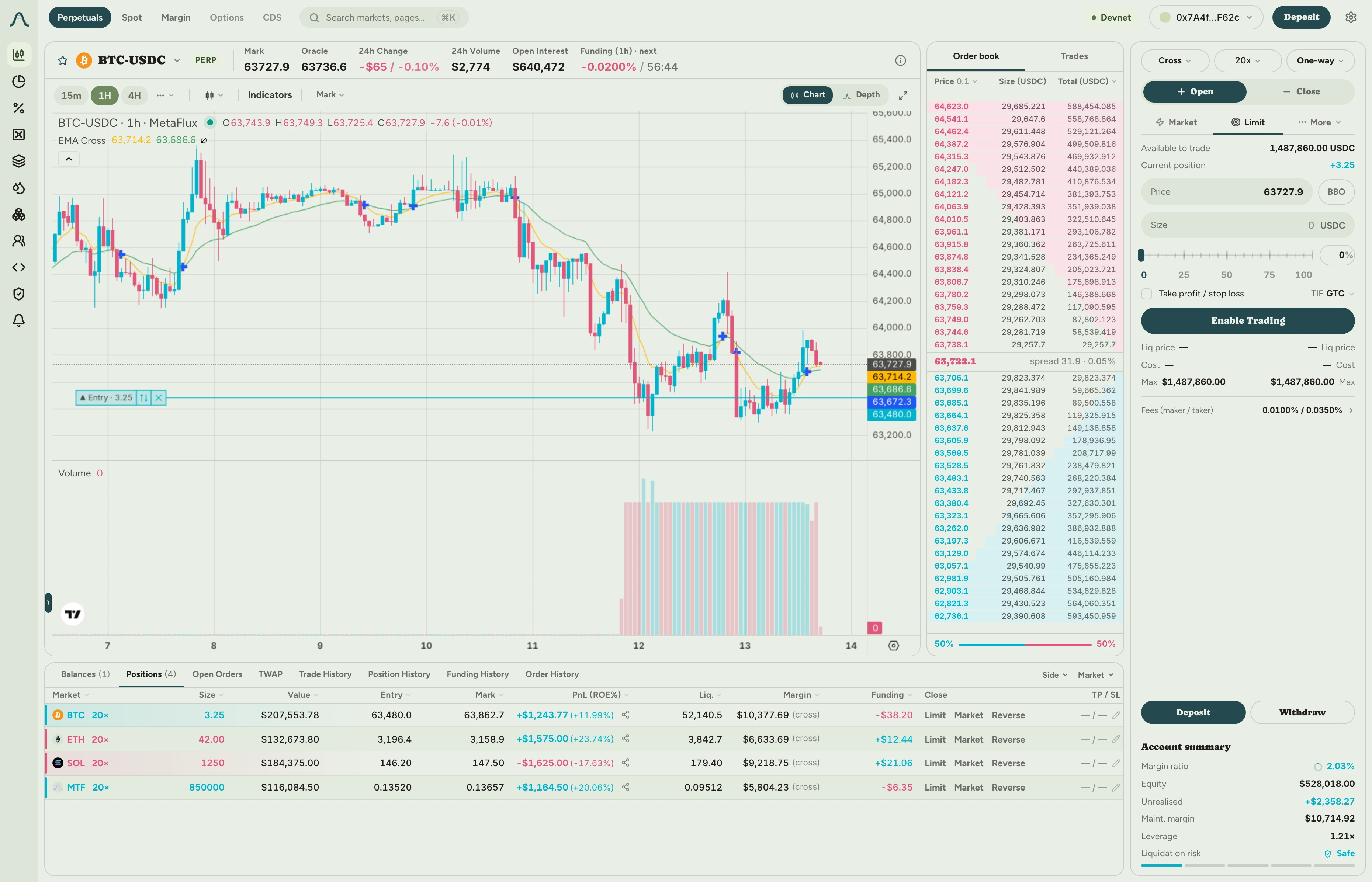
A parallel EVM, so your contract calls don't queue behind everyone else's. Portfolio margin that nets a hedged book to one number, not three. Matching that doesn't bleed to MEV. The things every serious trading desk has been asking for, on a chain that ships them.
Most new exchanges compete on lower fees. We're not interested in that race. MetaFlux is a bet that traders care more about market structure, risk infrastructure, and execution latency than they care about saving 0.2 bps a fill.
RFQ for size that shouldn't advertise on the book. Frequent batch auctions for markets where fairness beats latency. Matching encrypted at intake, revealed at settlement.
A SPAN-style scenario engine nets your hedged book to one number. A T0 yellow-card grace tier freezes resting orders before any position is touched — one block to react, not one tick.
Transactions execute optimistically and in parallel; conflicts re-run, the rest commit. Derivatives-aware precompiles (portfolio margin, ADL pricing, RFQ depth, vault NAV) run native — not as 80,000-gas Solidity.
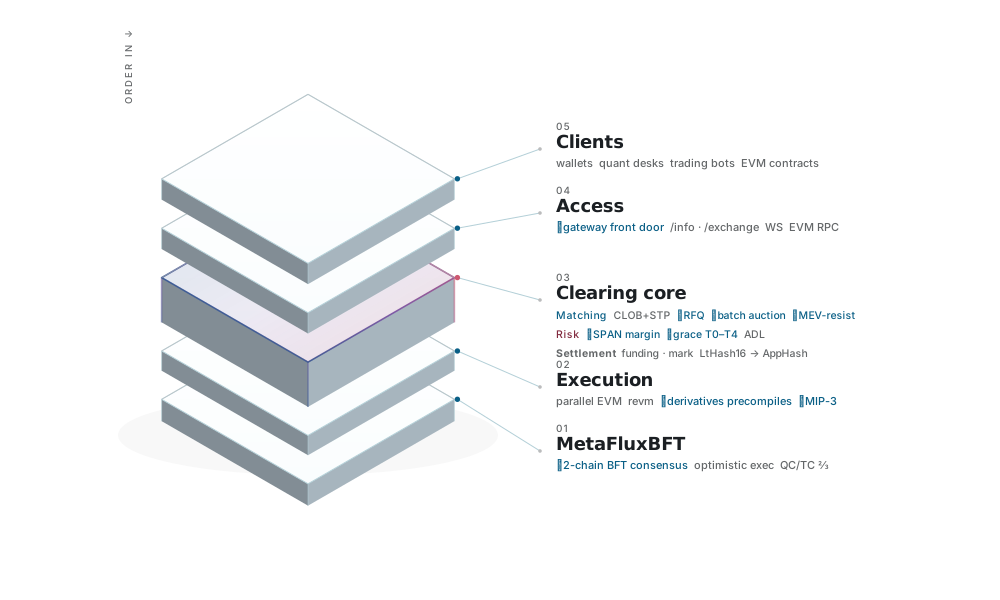
Not a contract on someone else's chain — the clearing engine is the chain. Matching, cross-asset margin, liquidation and settlement run native on MetaFluxBFT consensus, with a parallel EVM alongside for programmability. Here's the stack a signed order falls through.
Any builder can list a new perpetual or spot market via an on-chain gas auction. No protocol-team gate, no allow-list, no committee. The protocol arbitrates the auction; you ship the market.
Win the gas auction — the winning bid is burned — supply the spec (leverage, maintenance ratio, funding parameters, oracle source), and the market is live in the first block, taking orders the next. Liquidity is your problem; the protocol does the rest.
MIP-3 spec →Same address format, same signing, same Solidity. Plus derivatives-aware precompiles (portfolio margin, ADL pricing, RFQ depth, vault NAV) callable from any smart contract.
EVM docs →Your strategy ports unchanged: agent wallets, sub-accounts, vaults, cross/isolated margin, client order ids — the same primitives, one to one. The wire layer is MTF-native by design (no compatibility shim), and the SDK absorbs that rewrite: same EIP-712 signing, every EVM wallet works unmodified.
Approve a trading key once from your cold master. The agent signs every order without ever holding withdrawal authority. Per-bot scoping, automatic expiry, a clean audit trail.
Agent wallets →TypeScript and Rust SDKs speak the native surface — POST /info, POST /exchange, WebSocket — with typed fixed-point wrappers and hardware-signer support. The migration guide maps every action and query name from where you're coming from.
Migration guide →For deeper coverage, the documentation at docs.mtf.exchange has the complete API surface, concept catalog, and integration guides. This is just the highlights.
An independent L1 derivatives chain. Its own validator set, its own BFT consensus, its own EVM execution layer. Built from first principles for derivatives clearing, not borrowed from a general-purpose L1.
Specifically: Hyperliquid, dYdX (v4), Lighter, Aster. The honest table:
| Capability | MetaFlux | Hyperliquid | dYdX v4 | Lighter | Aster |
|---|---|---|---|---|---|
| L1 BFT consensus | yes | yes | yes | L2 | yes |
| EVM-compatible | yes | partial (HyperEVM) | no (Cosmos) | no | partial |
| Parallel EVM execution | yes | no | n/a | n/a | no |
| Cross-asset portfolio margin | yes | limited | no | no | no |
| T0 grace tier before partial | yes | no | no | no | no |
| RFQ + FBA matching | yes | no | no | no | no |
| MEV-resistant matching | yes | no | no | no | no |
| Permissionless market deploy | yes | yes | no | no | no |
| HL-familiar primitives (agents · subs · vaults) | yes | native | no | no | no |
Capability is one axis. Liquidity, fees, listings, and operational maturity are others. Pick the chain that wins on the axis you actually care about.
Mainnet follows audit and testnet milestones, not calendar dates. Devnet is live and open for integration now; a six-month public testnet precedes the TGE, with phased validator onboarding and the bridge audit as the explicit gating item. Subscribe to updates via the docs site.
MetaFlux speaks its own MTF-native protocol — one gateway serving POST /info, POST /exchange, WebSocket, and EVM JSON-RPC. The SDKs (TypeScript and Rust, preview) absorb the wire layer; the concepts — agent wallets, sub-accounts, margin modes — port one to one from other perp venues, and the wire is small enough to hand-implement from the typed-data signing spec. The EIP-712 envelope is standard and every EVM wallet works unmodified.
Genesis validator recruitment opens ahead of mainnet. The initial set is small and grows through the first year. Reach out via the validator inquiry below — we want operators with on-chain ops experience and geographic diversity.
Everything — USDC included — moves over MetaBridge, our validator-cosigned custody bridge: deposits credit on a two-thirds stake-weighted attestation quorum, withdrawals pass a dispute window before claim, and there is no admin key anywhere in the design — the bridge's trust assumption is exactly the chain's own. Corridors today: Base and Solana (test networks), Arbitrum next. It ships to mainnet only after the external audit.
The blue / pink / white reads cleanly as a brand system and isn't taken by anyone else in this space. It also signals what kind of community we want: technical, welcoming, and uninterested in the dominant aesthetic of the rest of crypto.
Devnet is open — no application, no allow-list. Grab test USDC from the faucet, point your client at the gateway, and trade. We're particularly interested in feedback from market makers and teams shipping production trading systems.